Every series of work begins with a question.
For me, Wings of Echo began with a quiet realization:
many events that shape our society do not disappear after they happen.
They remain, sometimes silently, inside our collective memory.
They echo.
As an artist living in Malaysia, I have witnessed moments that felt historically significant—moments filled with hope, uncertainty, disagreement, or change. Yet with time, many of these moments fade from public conversation. They become fragments of memory rather than ongoing reflection.
Wings of Echo is my way of responding to that.
Instead of documenting events directly, I chose to translate them into symbolic forms.
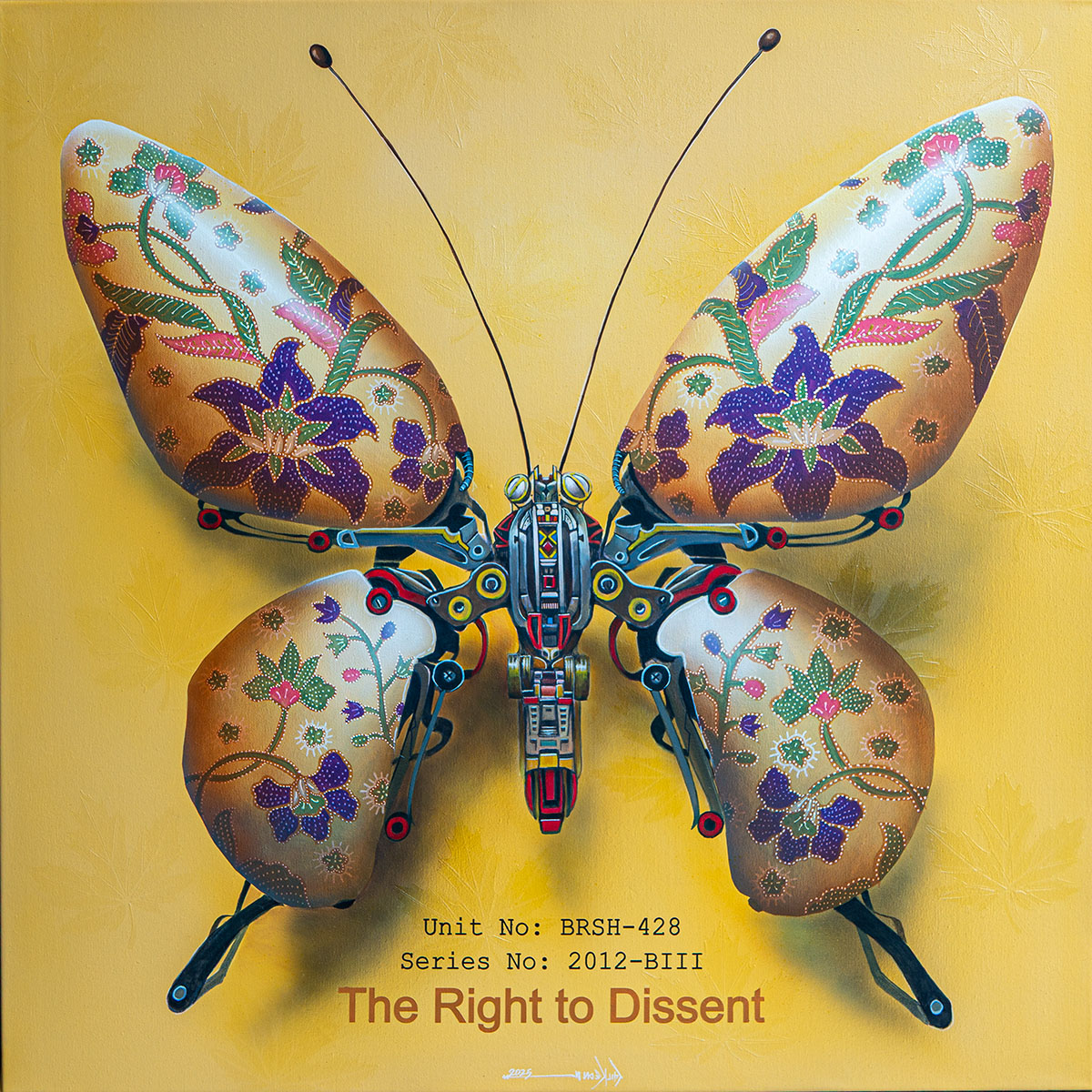
The central image of the series is the mechanical butterfly.
A butterfly traditionally represents fragility, transformation, and life.
In this series, however, the butterfly is not purely organic.
It is mechanical—constructed, engineered, and slightly unnatural.
This mechanical form reflects how modern societies operate:
systems, structures, technologies, and institutions all shape the way we experience reality. Individual emotions and historical events are often processed through these systems, sometimes becoming distant or abstract.
The butterfly therefore becomes a hybrid symbol—
part living creature, part machine.
It carries memory.
Each work in the series refers to a particular social or historical atmosphere in Malaysia. However, the works are not meant to function as direct political statements. Instead, they operate through metaphor, allowing viewers to approach the themes from their own perspective.
For example, “Bayang dan Arah – Shadow and Direction” reflects a moment when Malaysia found itself navigating between larger global forces. The mechanical butterfly appears delicate, yet its structure suggests tension between movement and control.
Another work, “Janji Hijau – The Green Mandate,” explores the idea of environmental promises and political commitments. The imagery does not accuse or judge directly. Rather, it invites viewers to reflect on the distance that sometimes exists between public promise and long-term reality.
In this way, the series attempts to hold memory without turning it into propaganda.
As someone who works professionally as an art restorer, I spend much of my time dealing with the past. Restoration teaches patience, humility, and respect for historical traces. It also teaches that preservation is never about rewriting history; it is about allowing traces of the past to remain visible.
This mindset has influenced Wings of Echo.
The works are not trying to shout loudly.
They are more like quiet records—visual notes about moments that once shaped our collective experience.
The echoes may fade with time, but they do not completely disappear.
Perhaps that is the role of art.
Not to give final answers,
but to keep certain questions alive.